The school's hours beyond lessons. Olympiad groups work four to six hours a week; the project club prepares an application for the TÜBİTAK High School Research Projects competition every year.
6 hours / week
Olympiad groups
Students join in the first month of grade 9 through trial lessons, not a selection exam.
Each group has a teacher in charge and two fixed weekly sessions. A separate study plan is written for every student sitting the first round of the TÜBİTAK Science Olympiads; those who reach the second round go to winter camp with a teacher from school.
6MathematicsTue, Thu 16:00–17:30 · Sat 10:00–12:00
4PhysicsMon, Wed 16:00–17:30
4ChemistryTue, Fri 16:00–17:30
3.5BiologyThu 16:00–17:30 · Sat 10:00–12:00
5Computer scienceMon, Thu 16:00–17:40
Weekly hours per olympiad group
Lab notebook
Projects are written the same way: research question, method, current result. Students are named by initials.
TÜBİTAK project · 2025–26 Ongoing
Microplastics in Bornova Creek
D. Y. and K. A., 11-B · Supervisor: Elif Demirtaş
Fig. 1
Question.
At three points of the creek closest to school, does the microplastic count rise after rain?
Method.
Since October, a 1-litre water sample from three points every two weeks; filtering, counting under the microscope and comparing with rainfall data.
Result.
In the first 12 measurements, post-rain samples show about twice the count. Measurements continue until the end of May.
TÜBİTAK project · 2025–26 Ongoing
CO₂ and attention in the classroom
E. K., M. T. and S. B., 10-A · Supervisor: Can Özdemir
Fig. 2
Question.
Does the classroom CO₂ level affect the result of a short attention test at the end of the lesson?
Method.
Per-minute CO₂ measurement in four classrooms with a sensor station we built; a five-minute attention test while ventilation breaks are varied.
Result.
Sensor calibration is complete; the first data set will be analysed in February.
Club project · 2025–26 Completed
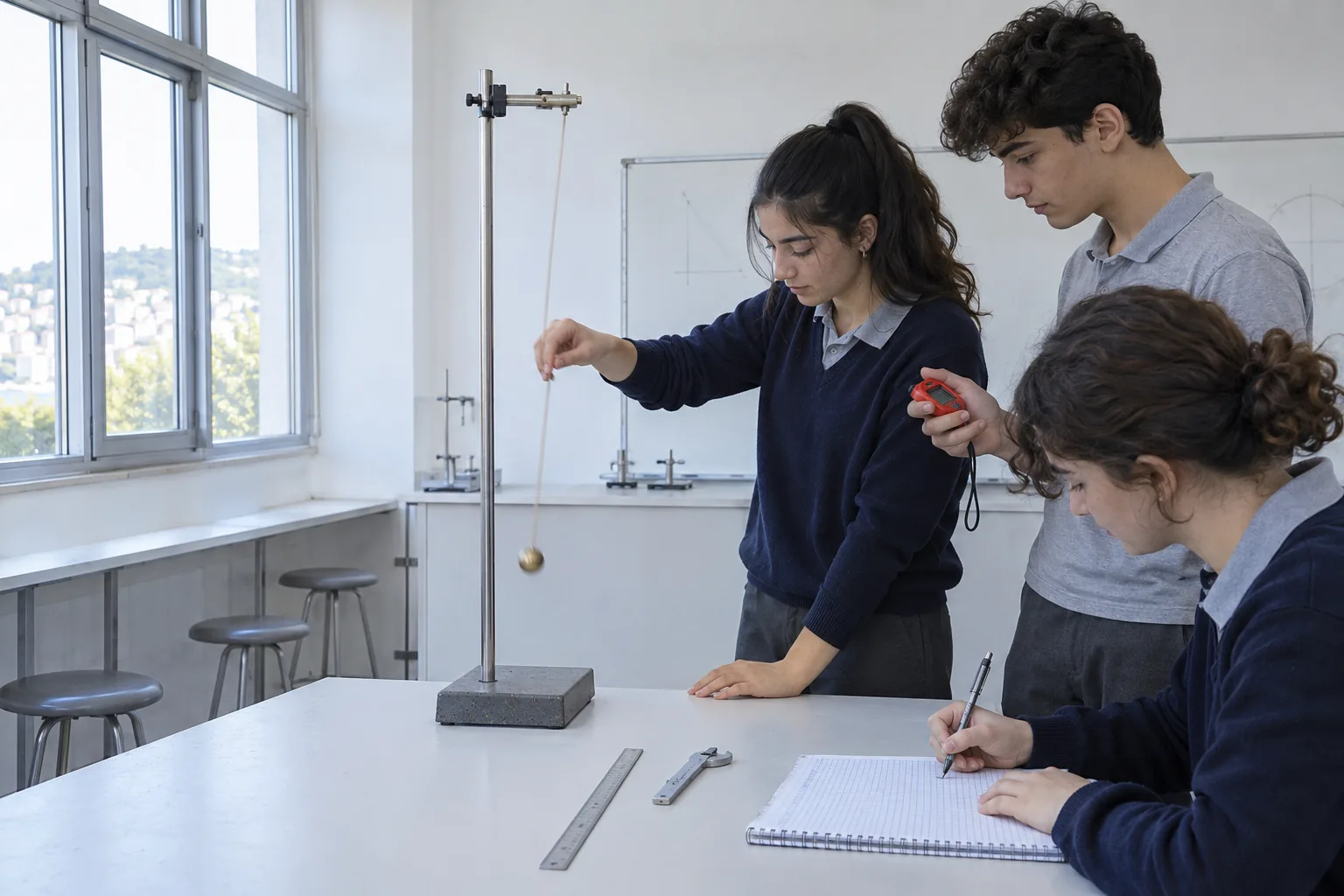
Measuring gravity with a pendulum
Physics club, grade 9 · Supervisor: Can Özdemir
Fig. 3
Question.
Can we measure g with less than one per cent error using a simple pendulum in the school lab?
Method.
Timing 20 swings at five different string lengths; g from the slope of the line between period squared and length.
Result.
g = 9.78 m/s²; 0.3% off the accepted value. The biggest error source is starting the stopwatch.
Olympiad work · 2025–26 Completed
The shortest path in a triangle
Maths olympiad group · Supervisor: Murat Erdem
Fig. 4
Question.
Where is the point whose total distance to the three vertices of a triangle is smallest, and how is it found with compass and straightedge?
Method.
A compass-and-straightedge construction of the Fermat point using equilateral triangles; the proof and the special case of angles over 120°.
Result.
The group wrote up the construction and the proof; the work became a lesson note for grade 9.
Club project · 2025–26 Ongoing
Smart irrigation in the school garden
Robotics and design workshop · Supervisor: Ozan Yıldız
Fig. 5
Question.
How much water does soil-moisture-based irrigation save compared with manual watering in the garden?
Method.
Two equal plots: one on a timer, one with the sensor system; a 3D-printed valve body; weekly water meter readings.
Result.
The system is installed; the comparison starts in spring.
How does a TÜBİTAK project run?
Sep–Oct. In the project club each student writes three research questions; one is chosen with the supervising teacher.
Nov–Dec. Literature review and method: how measurements are taken and what the control group is.
January. The application file is submitted on the TÜBİTAK calendar; an internal pre-jury meets a week before.
Feb–May. Measurements are repeated for projects going to the regional fair; others are shown at the school science fair.
Other clubs
Club
Area
Day & time
Teacher
Robotics and designArduino, sensors, 3D printing; small solutions for the school.
Science & technology
Wed 16:00–17:30
Ozan Yıldız
AstronomyTelescope observation and astrophotography.
Science & technology
Two nights a month, on the terrace
Can Özdemir
DebateWeekly debates and an inter-school tournament at year end.
Arts & culture
Fri 14:10–15:40
Haluk Sezer
BasketballSchool team and district league.
Sport
Tue, Thu 16:00–17:45
Okan Bilgin
VolunteeringMaths tutoring for middle schoolers at the neighbourhood library.
Community
Two Saturdays a month
Nilüfer Arslan
Cookies
This site only uses cookies that are necessary for it to work.Cookie Policy